RALEIGH, N.C., September 11, 2026 - BioPeak Health has released new consumer guidance explaining why the device used for red light therapy can matter as much as treatment time. The Raleigh health practice is drawing attention to wavelength, irradiance, and treatment coverage as practical factors consumers can examine when comparing devices.
The educational announcement addresses a growing point of confusion as handheld products, standing panels, and clinical full-body systems give consumers very different treatment formats. For people considering full-body red light therapy in Raleigh, BioPeak Health says minutes under a light alone do not provide enough information to compare one device with another.
BioPeak Health Highlights Device Differences Consumers Can Measure
Red light therapy, a form of photobiomodulation therapy, uses specific wavelengths of red and near-infrared light. Published research commonly examines wavelengths within approximately 600 to 1100 nanometers, with different wavelengths associated with different depths of tissue exposure.
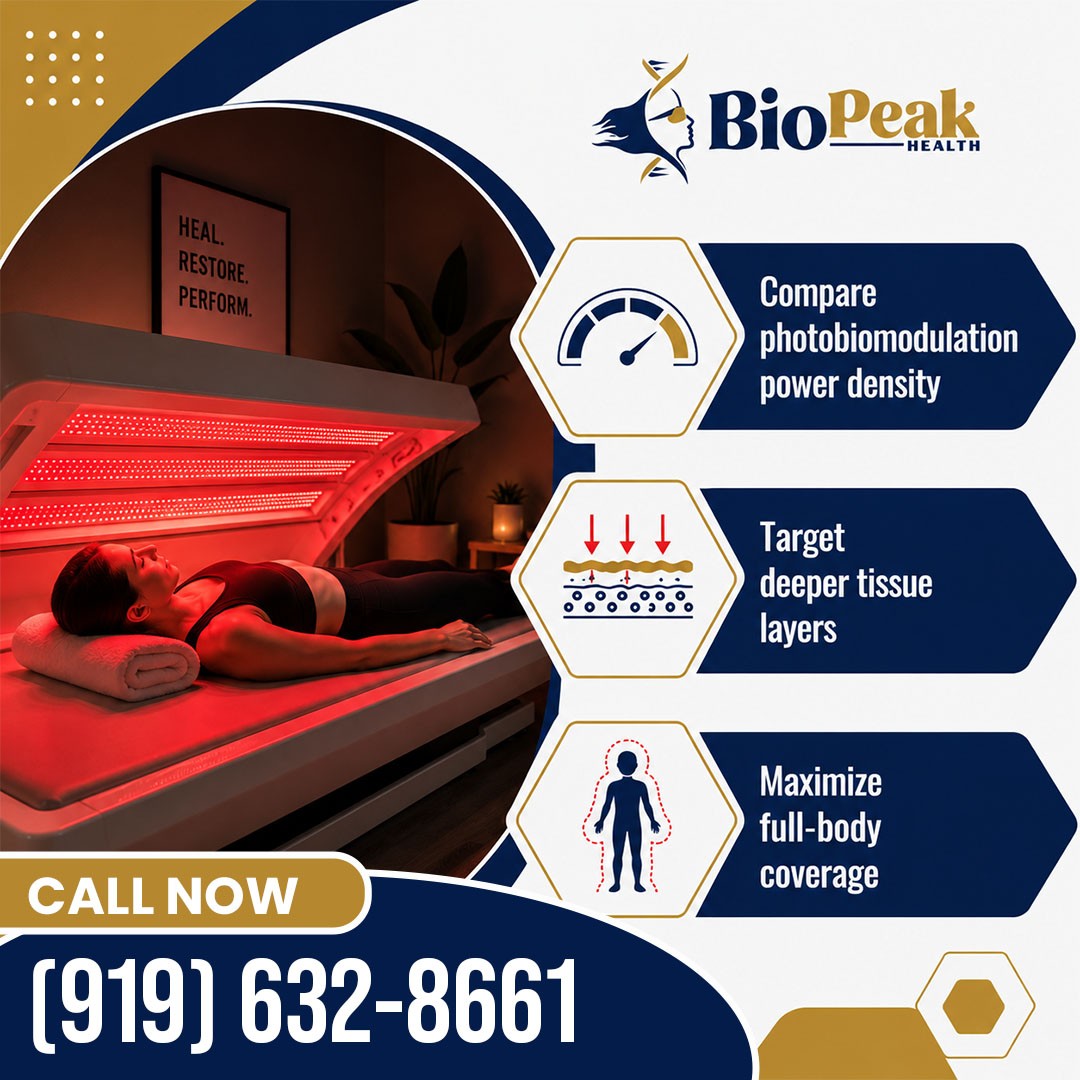
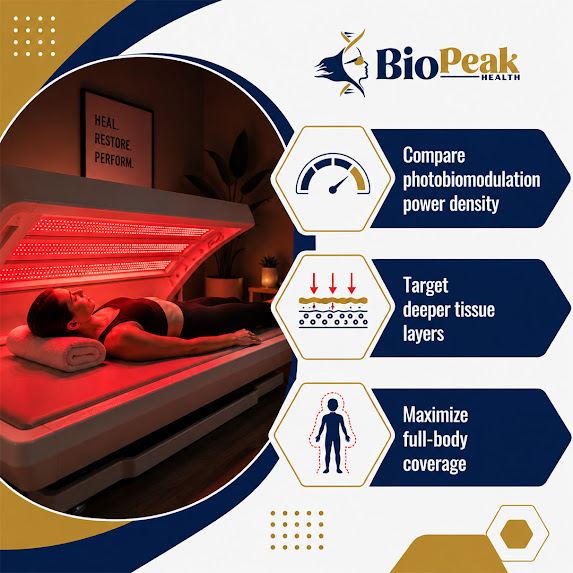
BioPeak Health's new guidance identifies three specifications that can help consumers make more informed comparisons.
Wavelength Affects How Light Interacts With Tissue
Visible red light is generally found toward the lower end of the therapeutic wavelength range, while near-infrared light uses longer wavelengths. Research into photobiomodulation has examined both ranges for different applications. This distinction means two devices marketed under the same broad red light therapy label may not deliver the same wavelengths.
Irradiance Helps Put Session Time Into Context
Irradiance measures the power density of light reaching a treatment area. A device's output is therefore an important part of understanding how exposure time relates to the delivered dose. A longer session is not automatically stronger or more appropriate. Comparing treatment time without considering device output can leave out a major part of the equation.
Treatment Coverage Separates Spot and Full-Body Devices
Coverage determines how much of the body can be exposed at one time. Handheld units are designed for smaller treatment areas and may need to be repositioned when several areas are being addressed.
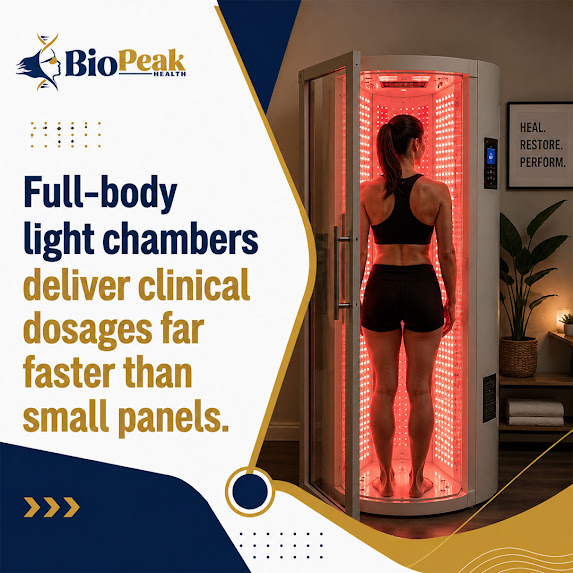
Full-body systems expose a larger surface area during one session. BioPeak Health’s TheraLight full-body bed at its Raleigh location contains more than 45,000 diodes, allowing light to reach a broad treatment area at once.
Session Duration Is Only One Part of the Dose
BioPeak Health's related educational material also addresses another common consumer question: how long a red light therapy session should last. Research protocols vary considerably in wavelength, power density, fluence, application method, and treatment schedule. Those differences make a universal time recommendation difficult to apply across every device.
Treatment Goals Can Change the Protocol
The intended treatment area is another consideration. A small, targeted area and widespread muscle recovery involve different amounts of tissue, while the equipment used can also change how the session is structured.
The same principle applies when comparing infrared light treatments. Two sessions lasting the same number of minutes should not automatically be considered equivalent when the equipment, output, and area exposed differ.
“The device is an important part of the red light therapy conversation because treatment is not defined by time alone,” said Dr. Chris Werness, BioPeak Health owner, Chiropractic Physician and Human Performance Consultant. “The characteristics of the light and the area being treated help put the length of a session into the proper context.”
Guidance Emphasizes Informed Use Rather Than Longer Sessions
The new educational material cautions against assuming that more exposure automatically produces a better result. Published research uses varying protocols, and treatment parameters can differ according to the equipment and intended application.
BioPeak Health also notes that red light therapy should not be treated as a replacement for diagnosis, physical therapy, chiropractic care, or another treatment plan recommended for a specific health concern.
The practice's educational resources are designed to help consumers understand measurable equipment characteristics before deciding whether to pursue treatment.
About BioPeak Health
BioPeak Health is a restorative and performance health practice located at 8364 Six Forks Rd., Ste. 102, Raleigh, NC 27615. The practice provides metabolic testing, genetic testing, VO2 max testing, personalized nutrition, chiropractic services, and wellness technologies for restorative health and human performance. The clinic also offers the SuperHuman Protocol, a structured approach that combines multiple wellness technologies, including full-body red light therapy, to support its focus on recovery and performance.
BioPeak Health is owned by Dr. Chris Werness, a Chiropractic Physician, Author, and Human Performance Consultant with more than 30 years in practice. His professional experience includes working with professional, collegiate, and recreational athletes.
Media Contact
BioPeak Health
8364 Six Forks Rd., Ste. 102
Raleigh, NC 27615
Phone: (984) 355-8822
Email: drchris@BioPeakHealth.com
Website: https://biopeakhealth.com/